



Pesantren Culture And Integrated Systems: Two Patterns of Reinforcing Worship Habituation in The Formation of Children's Religious Character

(1) * Muhammad Salman Alfarisi
 (Nurul Jadid University, Probolinggo, East Java, Indonesia)
Indonesia
(2) Hambali Hambali (Nurul Jadid University, Probolinggo, East Java, Indonesia)
Indonesia
(*) Corresponding Author
AbstractThis study explains peer dynamics, the forms and factors of Generation Z santri delinquency in the digital era, and Islamic boarding school responses from an Islamic education perspective. A qualitative multisite case study was conducted at Lubbul Labib and Al-Hamidiyah Islamic Boarding Schools in Probolinggo. Data were collected through in-depth interviews with ten informants, consisting of five santri and five administrators or religious teachers, supported by observation and documentation. Data were analyzed using the interactive model of Miles, Huberman, and Saldaña and cross-site analysis. Trustworthiness was maintained through source triangulation, member checking, peer debriefing, and negative case analysis. The findings show that peers operate as a dual social system; digital restrictions do not fully eliminate exposure and may stimulate creative violations; and the effectiveness of character formation is determined more by the institutionalization of personal-dialogical guidance than by sanction severity. These findings are synthesized into the Reflective Institutional Mediation model, which positions the boarding school as an active mediator of social and digital pressures through institutionalized personal guidance that strengthens santri internal control. |
Full Text: PDF

Refbacks
- There are currently no refbacks.
Copyright (c) 2025 Muhammad Salman Alfarisi
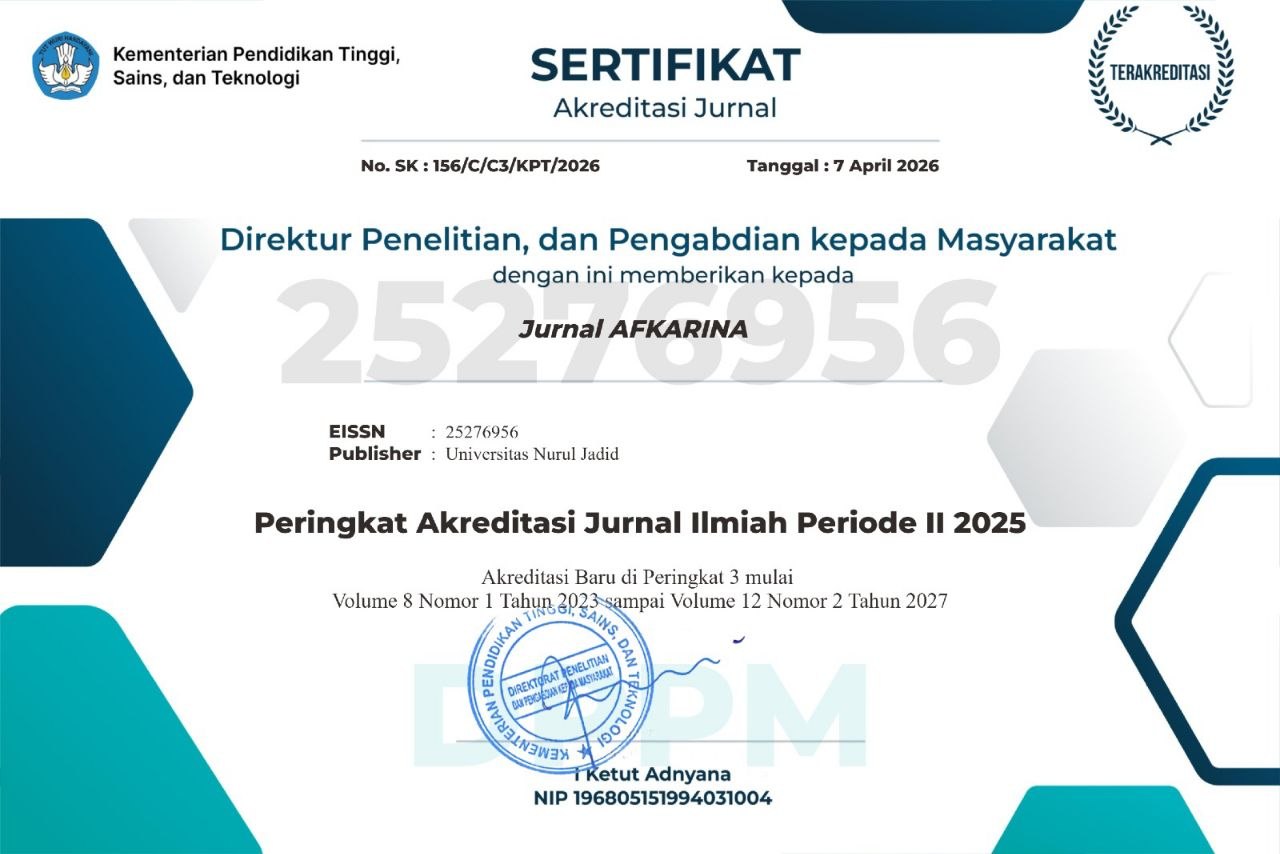
Afkarina: Jurnal Pendidikan Agama Islam
Published by The Lembaga Penerbitan, Penelitian, dan Pengabdian kepada Masyarakat (LP3M) of Nurul Jadid University, Probolinggo, East Java, Indonesia
